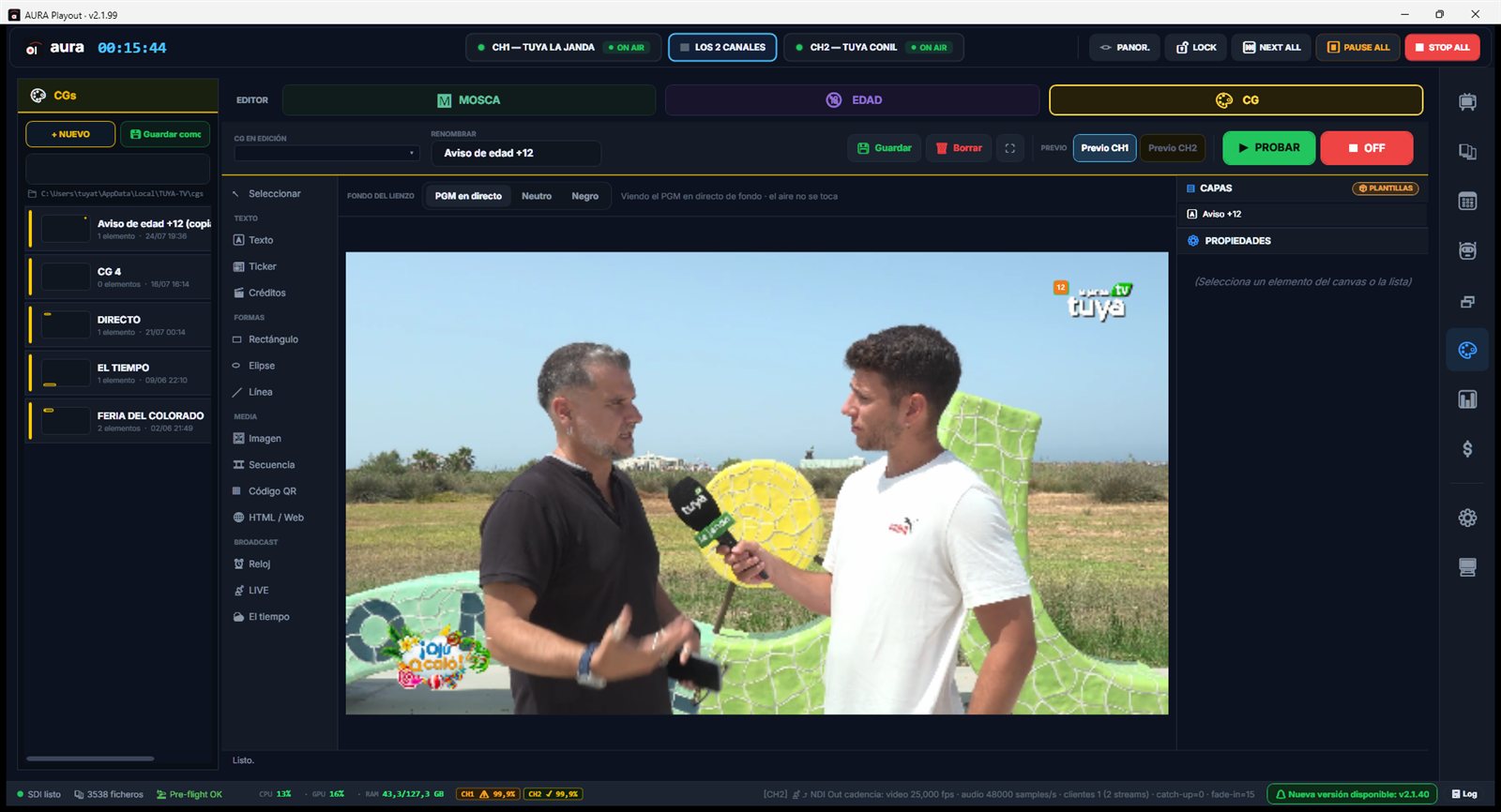
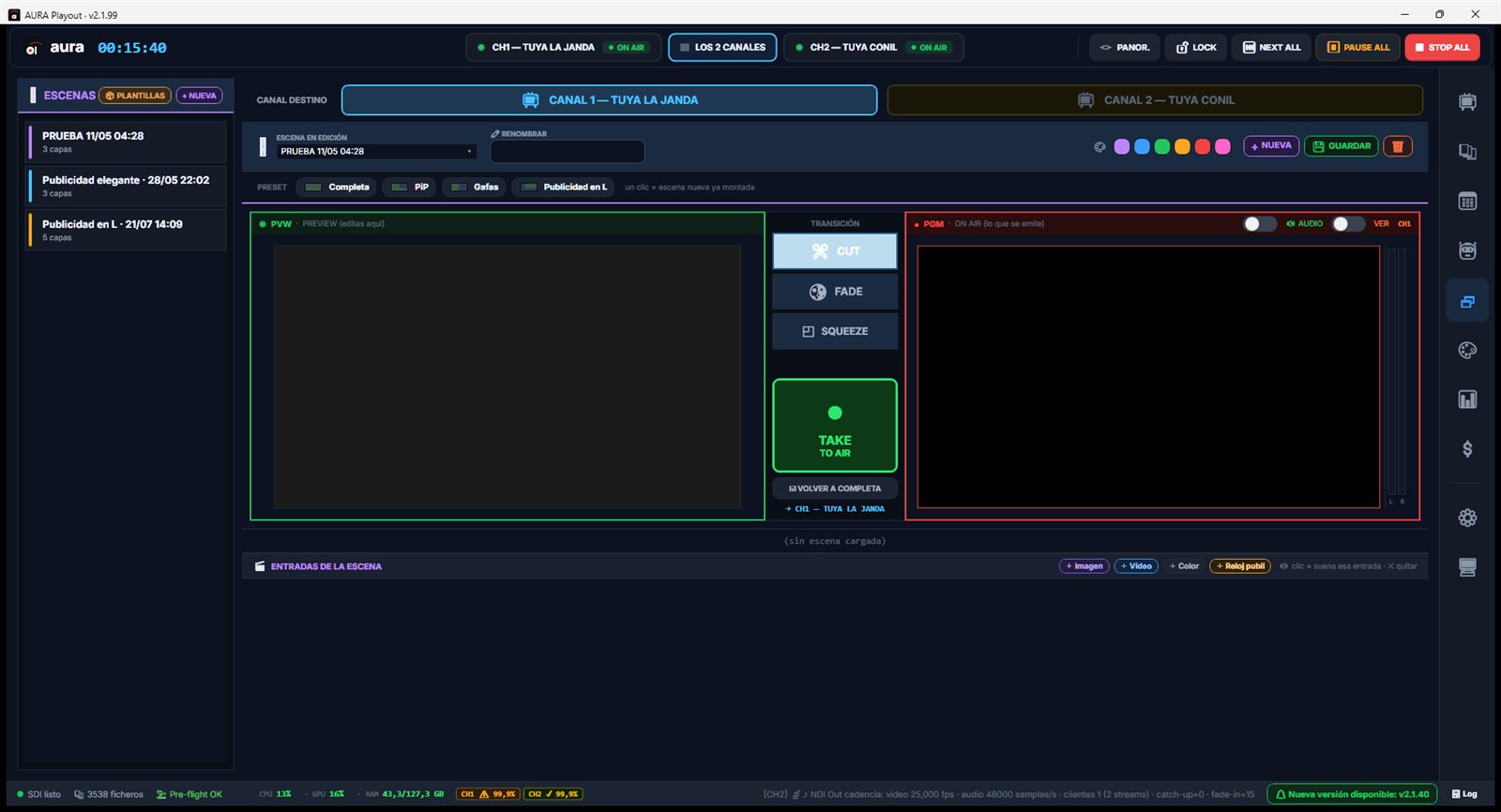
24/7 continuity with a real automation engine: weekly grid, break patterns, advertising with as-run reporting, and unattended recovery after a power cut.
Built for broadcasters who cannot afford dead air — and who do not have a night shift to babysit the channel.
Automation is not a playlist on shuffle. It is a set of rules that make the output look like a television channel: breaks where they belong, no repeats back to back, and a schedule that does not shift under the viewer once the EPG has been published.
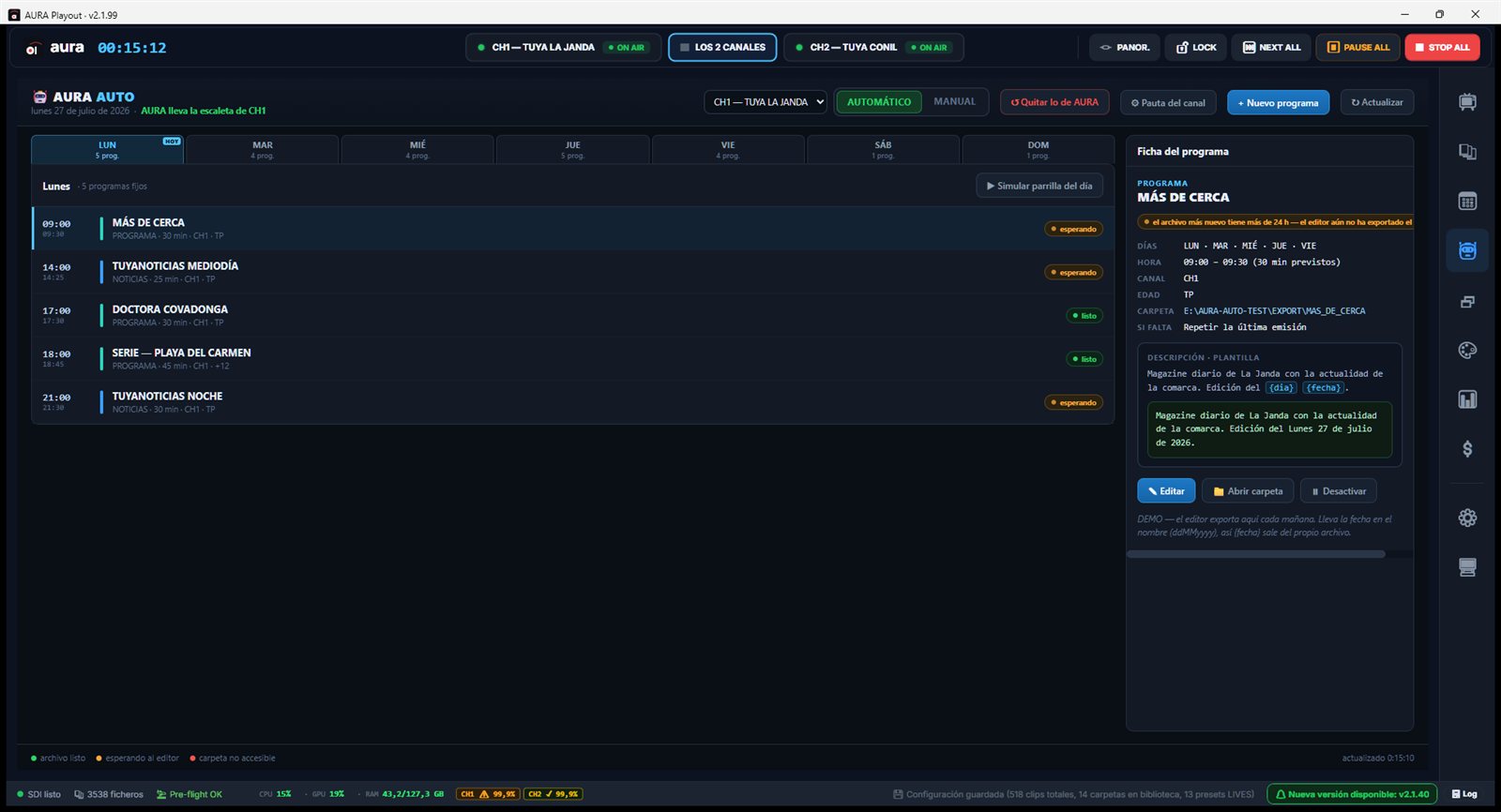
From a weekly grid and a continuity pattern, AURA lays out the programmes, the breaks, the bumpers and the promos — hours or days ahead. The day simulator lets you see how tomorrow will look with the material you have today.
Once laid down, the schedule is not reshuffled. The EPG has already reached the viewer, and a channel that changes its mind is a channel nobody can follow.
Never two parts of a programme back to back without a break in between. Never two bumpers in a row. Never a break shorter than the minimum you set — with a small inventory it builds more breaks rather than one short one.
The same spot will not return within 45 minutes, and commercials with similar names are spread apart too. With a small inventory it spreads them across more breaks instead.
Christmas content does not surface in July, nor Carnival in August. It reads the file names and the dates on disk, and repeats material from the last seven days unless a pattern deliberately asks for the archive.
If tonight's newscast is not ingested yet, it reserves the slot instead of inventing filler. If the hour arrives and it is still empty, it loops your filler — never black.
A sponsor bumper declared once follows its programme in and out — never between parts. Declare it on a whole folder and every programme inside inherits it, and every airing is logged with the programme it ran alongside.
If a programme has no subtitle file, AURA generates one with on-device speech recognition, in the background, long before it reaches air.
Not a feature list for a brochure: the things that decide whether a channel stays on air on a Sunday night with nobody in the building.
Two independent channels from one machine, each with its own rundown, branding, advertising and output. Blackmagic DeckLink cards.
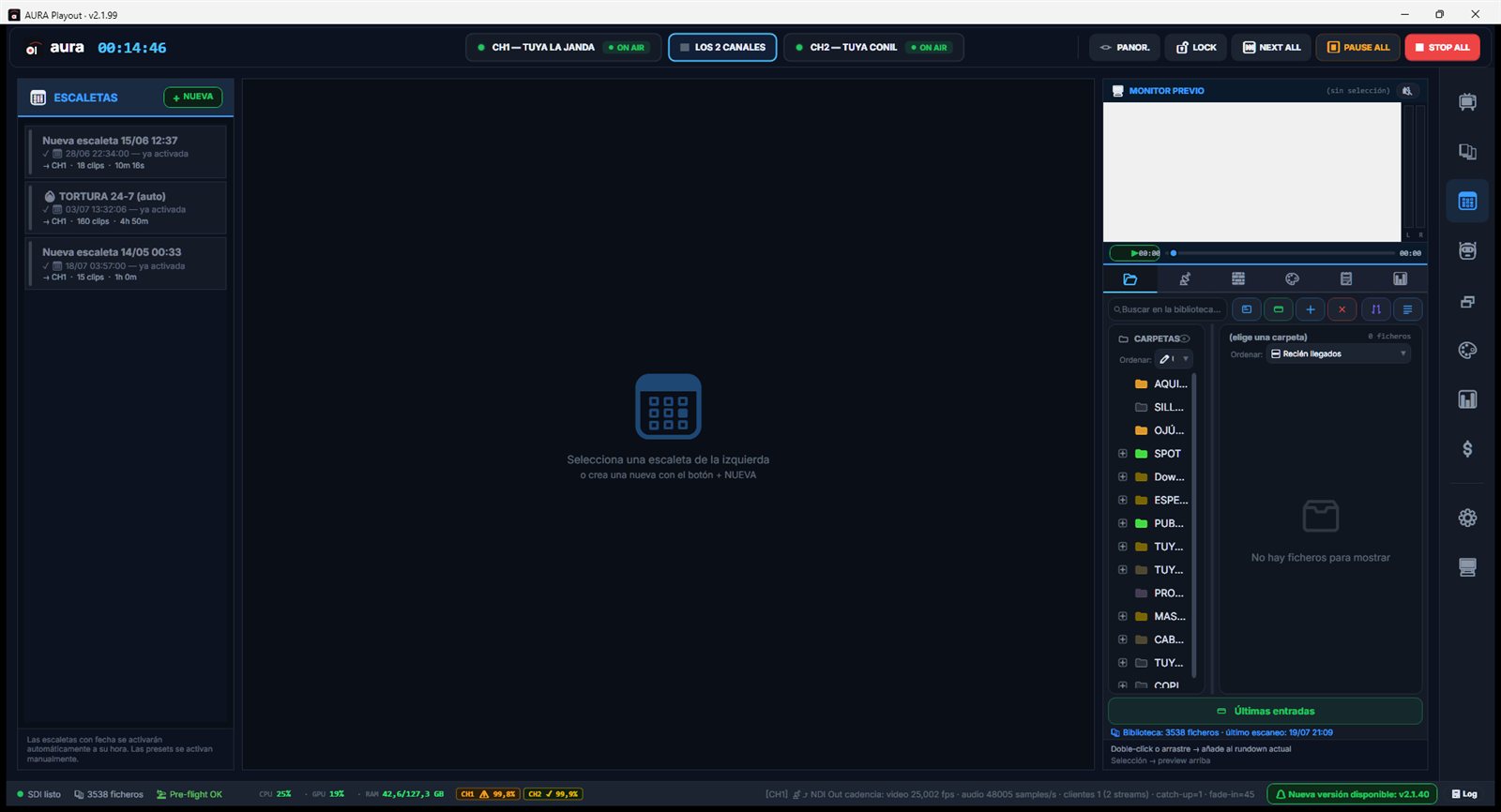
Build a rundown now and let it go on air at its time. Entry and exit times are calculated as you drop clips in.
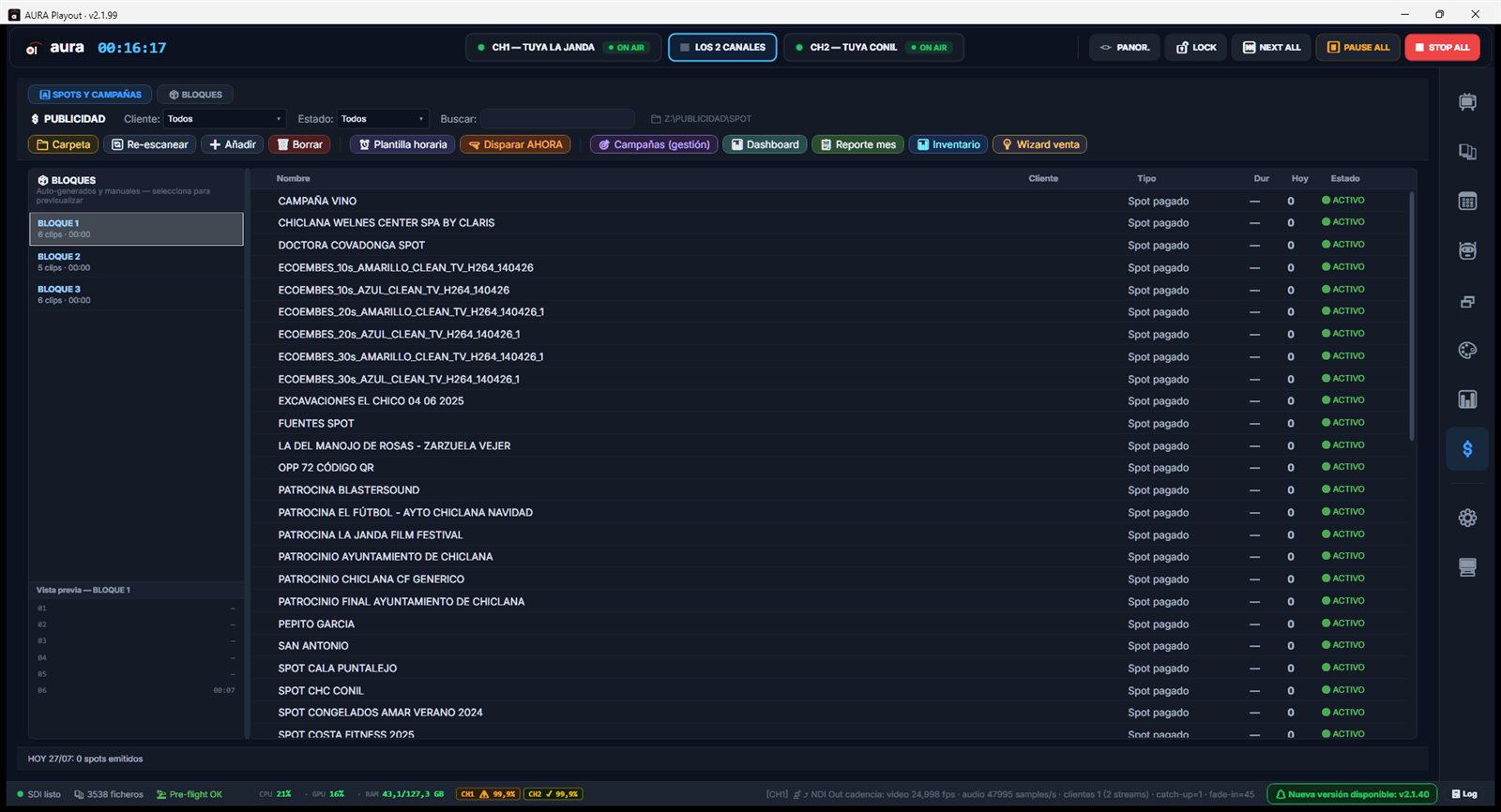
Spots with clients, campaign dates and pass quotas. Out of its window a spot simply does not air. Monthly as-run export to CSV and PDF.
Define the recipe once — length, bumpers, how spots are picked — and the engine builds every break to it.
AURA reopens with Windows, restores its state and resumes the output. Nobody has to drive to the station at three in the morning.
Bugs, lower thirds, tickers and clocks, with entry and exit animations. Designed inside AURA, no external character generator.
Picture in picture, dual window and the classic squeezeback in L — advertising during a long live without cutting away from it.
RTMP and SRT to platforms, MPEG-TS over IP to your head-end, and NDI around the building. All at once if you need it.
Frozen frame, missing file, disk filling up, card not responding — it detects them and pushes an alert to your phone.
No bolted-together modules from three vendors. One window, one licence, one place to look when something goes wrong.
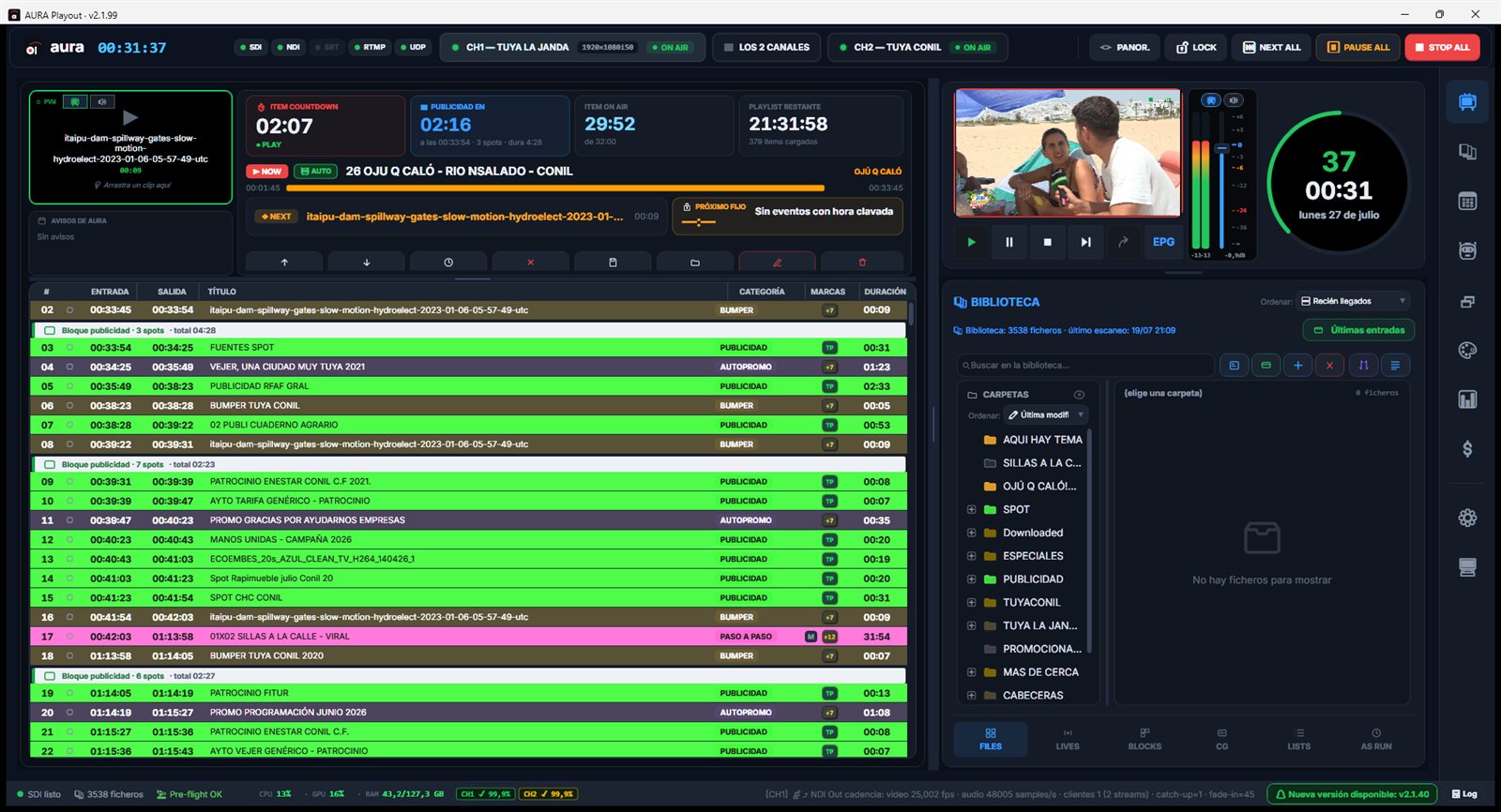
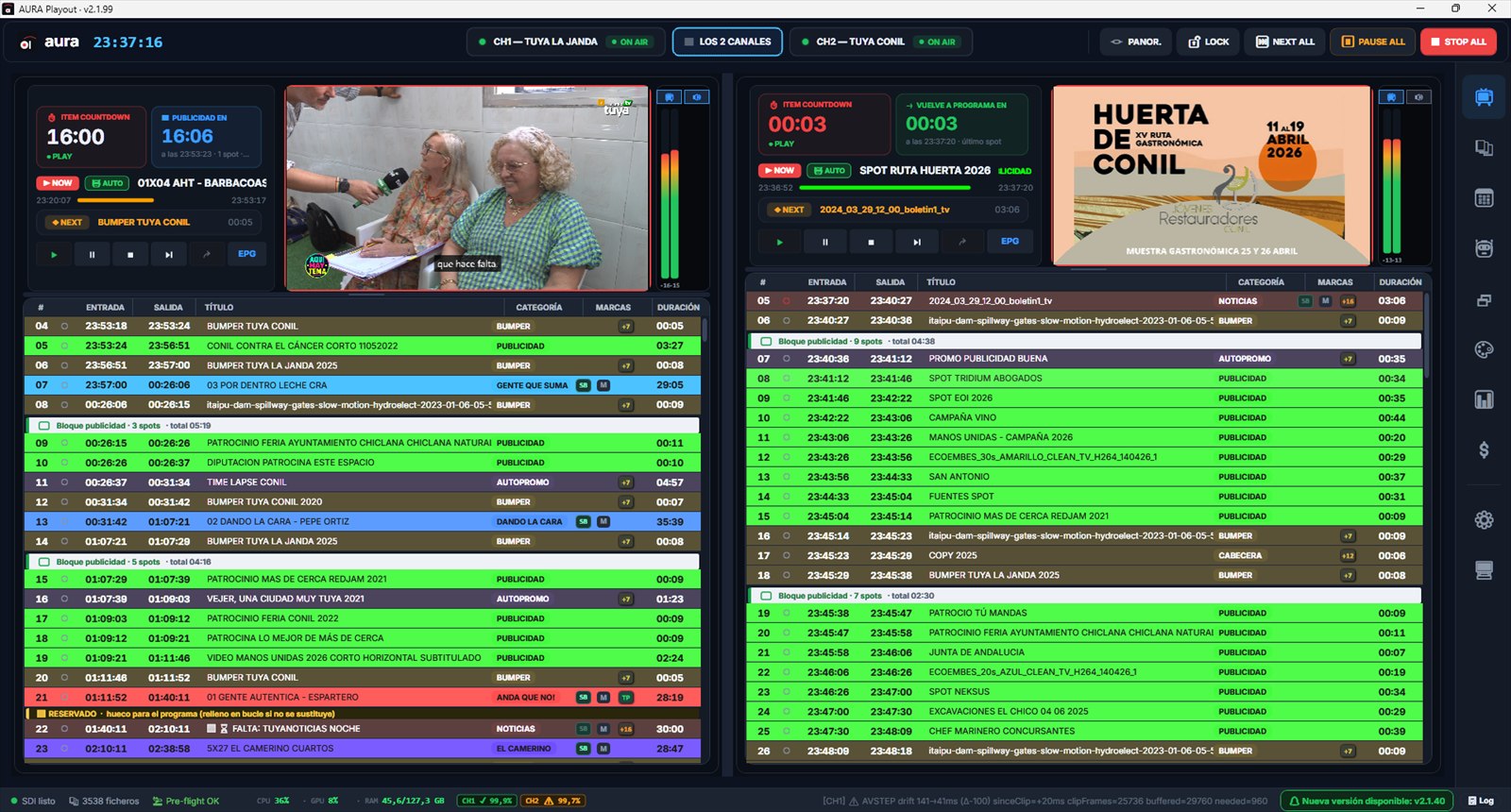
What is on air, what is next, how long is left and when the next break comes in. Programme and preview monitors, loudness metering and transport controls — all on one screen.
Colour-coded rundown by category, calculated times, and badges for what carries the bug, the age rating and subtitles.
Register the spot with its client, its campaign dates and its quota. The engine places it, the as-run log records it, and the monthly report proves it ran.
Sponsorships link to a programme — or to a whole folder — and travel with it in and out, so you can answer where a sponsor aired and alongside what.
Paint the week once. AURA fills it from your library, respecting your continuity pattern, and shows you the day before it happens.
Where content is missing it reserves the slot and tells you — with time to fix it, not at the moment it goes to air.
AURA is built for stations that broadcast every day with a small team.
SDI or MPEG-TS to the head-end, EPG, age rating and normalised loudness. Everything a distributor asks for before they accept your feed.
SCTE-35 ad markers so the platform can insert its own inventory. Without them, most platforms will not take a channel.
An in-house channel that runs unattended, with your own branding and scheduled content.
A 24/7 channel on YouTube or your own server, with real continuity instead of a looping playlist.
Long outside broadcasts with advertising in L, so you can monetise without cutting away.
Services and announcements with simple setup. The Basic licence is usually enough.
One payment and the software is yours for good. Start with the licence you need and add modules as the channel grows. No monthly fees. First year of updates included.
→ Swipe the table to see every licence. The feature column stays put.
|
BASIC
400 € + VAT
ONE-OFF · 1 IP CHANNEL
|
BEST SELLER FULL CHANNEL
1,500 € + VAT
ONE-OFF · 1 BROADCAST CHANNEL
|
2 FULL CHANNELS
2,200 € + VAT
ONE-OFF · SAVE 800 €
|
|
|---|---|---|---|
| CHANNELS AND OUTPUTS | |||
| Playout channels | 1 | 1 | 2 independent |
| Broadcast IP output — MPEG-TS to the head-end (multicast or unicast, H.264 or MPEG-2, constant bitrate for the modulator) | Yes | Yes | Yes, per channel |
| Streaming to platforms — RTMP · SRT (YouTube, Facebook, OTT) | Yes | Yes | Yes, per channel |
| SDI · HDMI output by card (DeckLink) | — | Yes | Yes, per channel |
| Resolutions | SD – HD – Full HD | SD – HD – Full HD – 4K UHD | SD – HD – Full HD – 4K UHD |
| Frame-rate families | 50 Hz and 59.94 / 60 Hz | 50 Hz and 59.94 / 60 Hz | 50 Hz and 59.94 / 60 Hz |
| NDI output | — | Yes | Yes |
| SCTE-35 ad break marking | — | Yes | Yes, per channel |
| Loudness normalisation (EBU R128 −23 LUFS / ATSC A/85 −24 LKFS) | — | Yes | Yes, per channel |
| Live sources | Streaming only | SDI · NDI · streaming · simulcast | SDI · NDI · streaming · simulcast |
| SCHEDULING AND CONTENT | |||
| Rundown with auto-advance and 24/7 loop | Yes | Yes | Yes |
| Media library | Basic, no categories | Full: categories, metadata, durations | Full, shared between channels |
| Rundowns scheduled by date and time | — | Yes | Yes |
| Multi-part programmes, never split by accident | — | Yes | Yes |
| Graphics: bug, age rating, ticker, QR, clock | — | Yes | Yes |
| Scenes with preview/programme: PiP, squeezeback in L | — | Yes | Yes |
| Burned-in and closed subtitles, with speech transcription | — | Yes | Yes |
| EPG / XMLTV with automatic variables | — | Yes | Yes |
| Exportable as-run log | — | Yes | Yes |
| SERVICE CONTINUITY | |||
| Watchdog with automatic restart | Basic | Yes, full | Yes, full |
| Recovery after a power cut, resuming the clip | — | Yes | Yes |
| Emergency filler (the channel is never black) | — | Yes | Yes |
| OPTIONAL MODULES | |||
| AUTOMATION — the automation engine, per channel | — | + 600 € | + 600 € per channel both together: 1,000 € |
| ADVERTISING — traffic and billing | — | + 300 € | + 300 € one module covers both channels |
| LICENCE AND SUPPORT | |||
| One-off payment, perpetual licence | Yes | Yes | Yes |
| Updates included | First year | First year | First year |
| Support | Email, 3 months | Email, 1 year + remote training | Priority, 1 year + training |
The full automation engine: weekly grid, continuity pattern, filler with memory, self-replacing advertising and linked sponsorships. On top of a full channel licence. Both channels together: 1,000 € (saving 200 €). Includes the day simulator, to see tomorrow’s schedule before it happens.
Spots and campaigns with contracts and quotas, breaks with a time template, dashboard, monthly report, inventory and a sales assistant. One module covers both channels. Spots outside their campaign stop airing by themselves, with nobody having to remember. On top of a full channel licence.
The first year is included in the licence price. From the second year on, 90 € a year if you want to keep receiving improvements and new versions. It is voluntary: if you do not renew, your version does not expire or shut down — it keeps broadcasting exactly the same, it simply stops receiving new features.
Prices in euros, VAT not included. Outside the European Union, VAT does not apply. Ask us for a quote in your currency — we invoice internationally.
Two things separate a video player from a professional playout: being able to mark the ad break for whoever distributes your signal, and delivering audio at the level the standard requires. AURA does both out of the box.
When your channel travels over cable, IPTV or a FAST platform, the distributor needs to know the exact second each break starts and ends, so they can replace it with their own or regional advertising. That is what SCTE-35 marks — and without it a channel will not be accepted by most platforms.
Our own injector, built into the UDP/MPEG-TS output. If anything failed on the marking side, the signal keeps going out untouched: it never takes the channel down.
Regulation requires that advertising does not sound louder than the programme, and operators reject feeds that miss the reference level. AURA measures perceived loudness in LUFS and corrects gain continuously.
The equivalent of a hardware loudness processor, built into the playout and with no added latency.
This is the most common misunderstanding, so let us settle it: delivering over IP does not mean delivering at lower quality. It depends on what you send over that IP.
A video cable to the head-end, with a Blackmagic DeckLink card. No compression and no latency. It is the way it has always been done and it remains perfectly valid.
Available formats are set by your card: AURA offers whatever it supports.
Broadcast quality, not internet quality. This is what modern head-ends ask for, and what integrators install when they remove SDI. AURA generates a complete transport stream:
Feeds a DTT modulator, an IRD, a cable head-end or an IPTV server.
A different purpose and different bitrates: here the recipient is a viewer on a phone, not the head-end.
SRT also works for contribution to a head-end when the link is the internet.
Takes the channel to another machine in the building with no cards and no video cables. It appears on the network under the channel name.
Needs gigabit: tens of megabits per channel in Full HD. Not for the internet.
All four can run at the same time from the same channel: the same programme going out over SDI to the head-end, over MPEG-TS to an IPTV server, over RTMP to YouTube and over NDI to the studio, simultaneously.
One engine for every format, in both frame-rate families. You do not buy a different product to move up.
Legacy channels and older head-ends. Still in service in plenty of places.
Lightweight HD, common in streaming and in some cable head-ends.
The broadcast standard today. 1080i 50 for European DTT, 1080i 59.94 in the Americas.
Full UHD chain: decoding, graphics, bug, subtitles and output.
4K UHD is complete through the chain; performance profiling on 4K capture hardware is still in progress. If you are building a UHD channel, talk to us — we would rather validate it against a real case.
Real numbers, not a wish list. A continuity machine should do one job and nothing else.
| COMPONENT | MINIMUM (1 CHANNEL) | RECOMMENDED (2 CHANNELS / FULL HD) |
|---|---|---|
| Operating system | Windows 10 64-bit | Windows 11 64-bit |
| Processor | 6 cores | 12 cores or more |
| Memory | 16 GB | 32 GB |
| Storage | SSD for system and software | NVMe SSD · media on NAS or local |
| Video card | GPU with hardware decoding | Blackmagic DeckLink for SDI |
| Network | 100 Mbps | Gigabit (required for NDI) |
If you are going to use automatic subtitle transcription, add 2 to 4.5 GB of memory while it works — it runs on-device, so your content never leaves the station.
Tell us how you broadcast today and what is giving you trouble. If AURA is not a fit, we will say so — it is cheaper for both of us than finding out later.
We answer in English and Spanish. Remote demo over a video call, on your own material.